
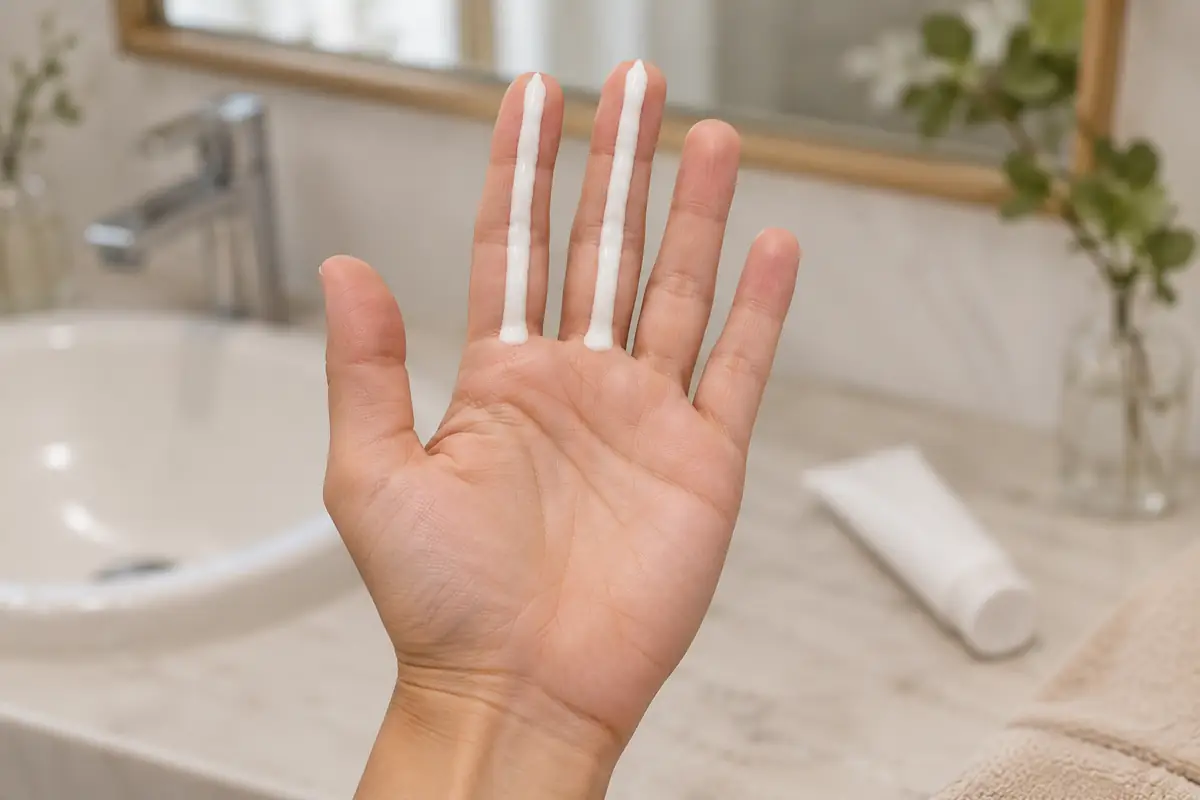
Most people use far less sunscreen on their face than the amount the SPF on the label is based on. Here is how much the American Academy of Dermatology (AAD) recommends, an easy way to measure it, the spots people most often miss, and how often to put it on again.
The short answer
- Amount: at least 1 teaspoon of sunscreen for your face. The AAD describes this as about enough to cover the length of your index and middle fingers.
- Don’t stop at the face: also cover your neck and ears, and use a lip balm with SPF 30 or higher.
- Timing: apply it to dry skin about 15 minutes before you go outside.
- Reapply: about every two hours while you are outdoors, and right after swimming or sweating.
Why the amount matters
The SPF number on a U.S. sunscreen comes from a standard laboratory test. Under FDA regulations, that test applies the sunscreen at 2 milligrams per square centimeter of skin. That is a much thicker layer than most people put on. The AAD notes that many people apply only about 20% to 50% of the amount needed to get the SPF shown on the label.
Using less than that does not just reduce protection a little. In a study of 20 volunteers published in the British Journal of Dermatology in 2007, researchers applied an SPF 4 sunscreen to the back in four different amounts. They found that protection rose and fell steeply with the amount applied: at half the test amount, the SPF fell roughly to its square root, and at a quarter of the test amount, to its fourth root.
To put that in perspective, here is a calculation, not a measured result: if the same pattern applied to an SPF 30 sunscreen, using half the test amount would leave protection closer to SPF 5 or 6. The study used a low-SPF product on the back, so the exact numbers may not carry over to the face. The practical message is the same as the AAD’s: put on enough. The AAD adds that a higher SPF helps make up for under-applying, but it does not let you stay outside longer without reapplying.
How to measure sunscreen for your face
The AAD’s guidance is to use at least 1 teaspoon on your face, “about the amount needed to cover the length of your index and middle fingers.” Two easy ways to get there:
- The two-finger method. Squeeze a line of lotion along the full length of your index finger and another along your middle finger. That is roughly the amount the AAD describes.
- Measure once with a teaspoon. If you are not sure, squeeze sunscreen into a measuring teaspoon the first few times so you learn what the right amount looks like in your palm. You do not need to measure every morning once you know.
You may see smaller amounts, such as a quarter teaspoon, suggested elsewhere. We follow the AAD’s “at least 1 teaspoon” guidance for the face. Cancer Council Australia gives similar advice: at least one teaspoon for the face, neck and ears, as part of about 35 mL (around 7 teaspoons) for the whole body. For comparison, the AAD and FDA say an average adult needs about 1 ounce, roughly a shot glass, to cover all skin not covered by clothing.
How to apply it, step by step
- Start with dry skin. The AAD advises applying sunscreen to dry skin 15 minutes before going outdoors. If you use a moisturizer, put it on first and let it settle.
- Dot it around your face. Spreading the measured amount in dots over your forehead, cheeks, nose and chin is a practical way to cover everything evenly. This is a tip, not something studies have tested.
- Cover the easy-to-miss spots. Work it out to your hairline, the sides of your nose, around (not into) your eyes, your ears and your neck. The FDA lists the ears, nose, lips, back of the neck and hairline among the places people often forget.
- Protect your lips. The AAD recommends a lip balm or lipstick with SPF 30 or higher.
- Wait before going out. The AAD says it takes about 15 minutes for your skin to absorb sunscreen and protect you.
The eyelid area is the most commonly missed
In a 2019 study, researchers photographed 84 adults with a UV camera after they applied an SPF 30 sunscreen or an SPF 30 moisturizer as they normally would. On average, people missed about 11% of the face with sunscreen and about 17% with the SPF moisturizer. The eyelid areas were missed most (14% with sunscreen and 21% with moisturizer), and participants did not realize they had missed them.
The AAD notes that sunscreen sticks are good to use around the eyes. Sunglasses with UV protection and a wide-brimmed hat also help cover this area.
How often to reapply
- Outdoors: reapply about every two hours, and right after swimming or sweating, following the directions on the label. The FDA says to reapply at least every two hours.
- Water-resistant sunscreen: the label must say whether it stays effective for 40 or 80 minutes while swimming or sweating. No sunscreen is waterproof or sweatproof.
- Higher SPF does not last longer. The AAD says high-SPF sunscreens last the same amount of time as lower ones.
Many people reapply over makeup with a sunscreen stick or a small amount of lotion patted on. Medical organizations do not give a specific method for this, so choose whatever lets you reapply in practice.
Does SPF moisturizer or makeup count?
The AAD notes that some moisturizers and cosmetics contain SPF and that they are convenient, but sunscreen still needs to be reapplied about every two hours when you are outdoors. Two cautions:
- Amount: the SPF on any product label comes from the same test at 2 mg per square centimeter. A thin layer of foundation or tinted moisturizer is unlikely to reach that amount, so it may not give the protection on the label.
- Coverage: in the UV-camera study above, people missed more of their face with an SPF moisturizer than with sunscreen, especially around the eyes.
A simple approach is to use a dedicated sunscreen, at the full amount, as the last step of your morning routine, and treat SPF in makeup as extra.
Choosing a face sunscreen
- The basics: the AAD recommends broad-spectrum protection (UVA and UVB), SPF 30 or higher, and water resistance. The FDA and CDC set a lower minimum of SPF 15, so SPF 30 or higher meets both.
- Sensitive skin: dermatologists recommend mineral sunscreens, with zinc oxide or titanium dioxide as the active ingredients, for people with sensitive skin, according to the AAD.
- Dark spots: visible light from the sun can worsen dark spots, especially in darker skin tones. The AAD says tinted sunscreens containing iron oxide help protect against visible light.
- Texture: the AAD notes that creams are best for dry skin and the face, and gels suit oily skin.
- Sprays: the FDA says spray sunscreen should never be applied directly to your face. A practical alternative is to spray it into your hands, away from your face, and rub it in. The AAD also advises against spraying near the face or mouth.
The best sunscreen is the one you will use every day, in the right amount. For specific products, see our comparison of the best sunscreens for daily use.
Frequently asked questions
Do I need sunscreen on cloudy or winter days?
Yes, if you will be outside. The AAD says up to 80% of the sun’s UV rays can get through clouds, and that your skin is exposed to UV every time you go outside, including in winter. The CDC adds that UV reflects off water, sand, snow and cement.
Does sunscreen protect through a window?
Window glass blocks UVB, the main cause of sunburn, but UVA rays, which age the skin, can pass through it, according to the AAD. If you spend long periods next to a sunny window, such as while driving, that is worth keeping in mind.
How long does a bottle of face sunscreen last?
Used at 1 teaspoon (about 5 mL) a day, a 50 mL (1.7 oz) tube lasts roughly 10 days, and longer only if you skip days. That is a calculation from the AAD amount, not a label claim. If a bottle lasts you months, you are probably using too little. For older bottles, the FDA says a sunscreen without an expiration date should be considered expired three years after purchase; throw it out if the color or texture has changed, the AAD adds.
Can I use sunscreen on a baby’s face?
Not usually for babies younger than six months. The FDA does not recommend sunscreen for infants under six months and says to ask a doctor first. Keep young babies in the shade and in protective clothing instead.
What if sunscreen irritates my skin?
Cancer Council Australia suggests patch testing a new sunscreen on a small area of skin first, and looking for fragrance-free products if you have sensitive skin. If a sunscreen causes a rash, stop using it and talk to a doctor or pharmacist. A mineral sunscreen may be easier to tolerate.
Related guides
- Best sunscreens for daily use
- Skincare routine for beginners: 3 simple steps for healthy skin
- Best moisturizers and lotions for dry, sensitive skin
- All skin and beauty articles
Sources
- American Academy of Dermatology. How to apply sunscreen (last updated August 15, 2025).
- American Academy of Dermatology. Sunscreen FAQs (last updated February 11, 2025).
- U.S. Food and Drug Administration. Sunscreen: how to help protect your skin from the sun (content current as of October 16, 2026).
- Code of Federal Regulations. 21 CFR 201.327: Over-the-counter sunscreen drug products; required labeling based on effectiveness testing (SPF test application amount, section (i)).
- Centers for Disease Control and Prevention. Sun safety facts (June 17, 2026).
- Cancer Council Australia. Advice on how to choose, apply and store sunscreen.
- Faurschou A, Wulf HC. The relation between sun protection factor and amount of sunscreen applied in vivo. British Journal of Dermatology. 2007;156(4):716-719.
- Lourenco EAJ, Shaw L, Pratt H, et al. Application of SPF moisturisers is inferior to sunscreens in coverage of facial and eyelid regions. PLoS One. 2019;14(4):e0212548.
Written by the PromaxHealth Editorial Team with AI assistance; this article has not been reviewed by a clinician and is not medical advice. Featured image: AI-generated with ChatGPT for PromaxHealth on November 11, 2026.