
By PromaxHealth Editorial Team
Prepared with AI assistance and checked against the linked public-health sources. This article has not been medically reviewed.
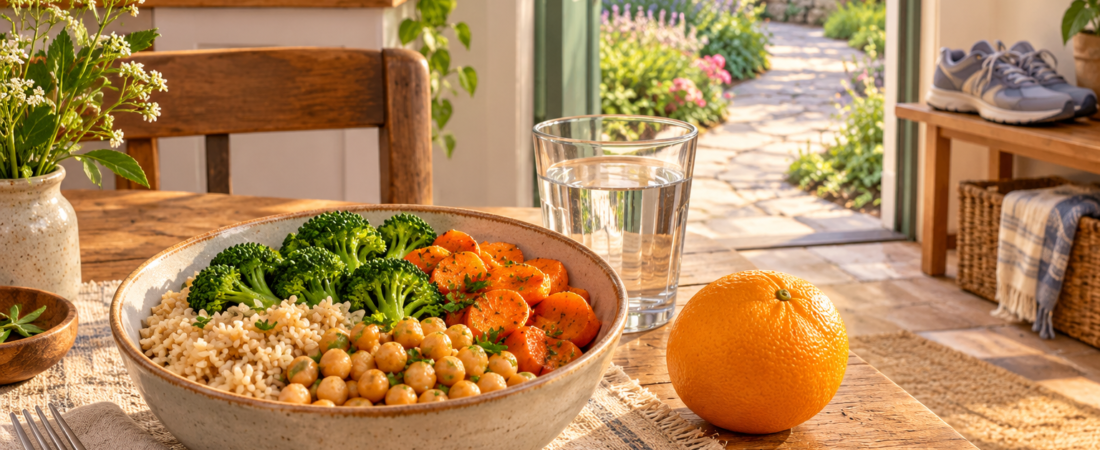
Featured image: AI-generated illustration for PromaxHealth; food portions are illustrative.
You can start eating more balanced meals and moving more without buying special foods or following a demanding workout schedule. Choose one meal to improve and one manageable opportunity to move. Build from there at a pace that fits your life.
This guide is for generally healthy adult beginners. Adapt the examples to your appetite, culture, budget, food access, and abilities. The seven-day checklist is a practice week, not a weight-loss prescription or a promise of results.
Build balanced meals with familiar foods
Use a flexible plate pattern
A practical starting point is roughly half vegetables and fruit, one-quarter whole grains, and one-quarter protein foods. Beans, lentils, eggs, tofu, fish, and poultry are possible protein choices. The pattern works for bowls and mixed dishes, too; you do not need separate compartments. These proportions come from Health Canada’s food guide plate.
The plate describes proportions, not a fixed serving size or a complete daily menu. Your needs may differ with your health and activity. If dinner is usually rice and chicken, begin by adding vegetables. You can work toward more variety over time.
Make one meal you can repeat
For a simple rice-and-chickpea bowl, combine cooked brown rice, drained chickpeas, and cooked broccoli and carrots. Aim for vegetables to make up about half the bowl, with rice and chickpeas sharing the rest. Add lemon, a little olive oil, and seasonings you enjoy. Have an orange or another fruit alongside if you like.
Use another grain if that is what you have. Swap chickpeas for lentils, tofu, eggs, or another suitable protein. Adjust quantities to your appetite and use ingredients that fit any allergies or prescribed dietary restrictions. This is a meal idea, not a nutritionally calculated daily plan.
For another lunch option, try PromaxHealth’s published 15-Minute Mediterranean Chickpea Salad. Add whole-grain bread or another grain if you want a fuller meal. The recipe includes dairy; adapt it for your needs. Its optional shopping links are affiliate links, and no purchase is needed to follow this guide.
Eat well on a realistic budget
Start with your cupboard and freezer. Choose two meals that share ingredients, then write down only what is missing. For example, chickpeas can go into both a vegetable bowl and a salad; carrots can be cooked for dinner or served with lunch.
Compare local prices, package sizes, and what you will actually use. A large bag is only good value if you can store and finish it.
| If this is expensive or inconvenient | A practical alternative |
|---|---|
| Fresh vegetables that spoil before you use them | Plain frozen vegetables, cooked a portion at a time |
| Meat in every meal | Replace some or all of it with beans or lentils |
| Individual breakfast pots | Plain oats with milk or yogurt and fruit, assembled at home |
| Frequent takeaway lunches | Pack a grain-and-bean bowl or a homemade sandwich with vegetables |
| A recipe requiring several new ingredients | Choose a simpler version using foods you already enjoy |
Fresh, frozen, canned, and dried foods can all fit a healthy eating pattern. Compare labels for sodium, sugars, and saturated fat when choosing packaged foods, as Health Canada advises. Choose the option that fits your budget and dietary needs; no single product is always the cheapest or best.
Start moving at a manageable pace
Find your starting point
Try up to five comfortable minutes of walking, wheeling, or another accessible activity. Start with less if needed. Use a safe route or indoor space and make the first part especially easy. You can repeat a short session before adding time.
Attach it to an everyday cue: after lunch, after work, or before your evening routine. If the session leaves you feeling unwell or unusually exhausted, reduce it and seek advice when needed. Pain is a reason to stop, not a sign of a successful workout. MedlinePlus recommends gradual progression and learning suitable technique.
Build toward the adult weekly recommendations
The WHO adult recommendations are 150–300 minutes of moderate-intensity aerobic activity a week, or 75–150 minutes of vigorous activity, or an equivalent combination. Add muscle-strengthening activity at moderate or greater intensity for all major muscle groups on at least two days weekly. These are ongoing targets, not a first-week assignment. Some activity is better than none.
Adults aged 65 and older should also include varied activity that emphasizes balance and strength at moderate or greater intensity on at least three days weekly, adapted to their abilities. WHO describes this additional recommendation in the same guidance.
The aerobic minutes can be spread across the week in short sessions, according to CDC’s adult activity overview. Strength work is an additional component; it does not replace the aerobic target.
To judge effort, use the CDC talk test: at moderate intensity, you can usually talk but cannot sing; at vigorous intensity, you can say only a few words before pausing for breath. Your effort matters more than someone else’s pace. An easy stroll provides movement but may not reach moderate intensity.
Add strength and progress gradually
If suitable for you, practice a few slow chair stands using a sturdy chair that will not slide, or wall push-ups on a clear, stable surface. Stop before your technique breaks down and do not push through pain. These are introductory examples, not a routine covering every major muscle group.
As you develop a routine, include the legs, hips, back, abdomen, chest, shoulders, and arms—the muscle groups listed in CDC’s guidance. A qualified exercise professional can help select movements and adaptations.
After your practice week, repeat what feels manageable. When ready, change one thing: add a minute or two to a session, for example. Do not increase frequency, duration, and intensity all at once. Allow recovery between strength sessions. This gradual approach follows MedlinePlus exercise-safety advice; the exact progression should suit you.
Be cautious with supplements
Supplements cannot replace a varied eating pattern. Some meet specific needs, but buying a general “wellness stack” is not a step in this plan. Ask a clinician or registered dietitian whether you need a supplement and what dose and duration are appropriate. NIH’s Office of Dietary Supplements explains their uses and limits.
Check with a pharmacist or clinician before adding supplements if you take medicine. Vitamin K can reduce warfarin’s effect, and St. John’s wort can reduce the effectiveness of several medicines, including some birth-control pills. High doses and overlapping products can cause harm. “Natural” does not mean safe, and independent quality seals do not guarantee safety or effectiveness. Tell your care team about supplements before surgery and seek advice during pregnancy or breastfeeding. Never replace prescribed treatment with a supplement. These cautions are detailed in NIH ODS’s safety guidance.
Keep a list of each medicine and supplement, including its name, dose, frequency, and reason for use, and bring it to appointments.
Your seven-day beginner checklist
Tick off what you try. Repeat, shorten, or skip a task that does not suit your needs. These original practice prompts are not a clinically tested program, and the week does not attempt to meet the full activity targets.
| Day | Food task | Movement task |
|---|---|---|
| 1 | ☐ Check your cupboard and choose one simple meal. | ☐ Try up to five comfortable minutes of suitable movement, or less if needed. |
| 2 | ☐ Add vegetables or fruit to a familiar meal. | ☐ Repeat the amount that felt manageable on day 1. |
| 3 | ☐ Include beans, lentils, eggs, tofu, or another suitable protein in a meal. | ☐ If suitable, practice a few controlled chair stands or wall push-ups. |
| 4 | ☐ List what you need for two meals with shared ingredients. | ☐ Repeat a comfortable session; add a minute or two only if ready. |
| 5 | ☐ Make the chickpea bowl or another balanced meal. | ☐ Replace one sitting break with gentle movement. |
| 6 | ☐ Choose tomorrow’s meal and set aside any shelf-stable ingredients. | ☐ Try a second brief strength practice if recovered and comfortable; otherwise rest or move gently. |
| 7 | ☐ Note one affordable meal worth repeating. | ☐ Review what felt manageable and schedule next week’s activity. |
If the week felt difficult, keep the same starting point or make it smaller. If it felt comfortable, choose one modest next step. There is no need to make up missed days with a harder session.
Know when to get individual advice
This article provides general education, not diagnosis or individualized care. CDC advises people with chronic health conditions to discuss suitable activity with their doctor. It also advises checking before starting vigorous activity if you have been inactive, have a disability, or have overweight.
Pregnancy, recovery from illness or surgery, significant mobility limitations, a prescribed diet, or a history of an eating disorder can change what is appropriate. Ask your care team how to adapt food and activity choices rather than treating this checklist as a prescription.
Stop exercising if you develop pain. Seek medical advice for persistent muscle or joint pain. For chest pain during or after exercise, call your local emergency number or seek emergency care immediately. See MedlinePlus’s exercise-injury guidance. Stop and seek help for dizziness or extreme shortness of breath, too; MedlinePlus lists these exercise warning signs.
Beginner FAQs
Do I have to change every meal?
No. Start with one change you can repeat: add vegetables to dinner, assemble an easy lunch, or plan a breakfast you enjoy. Work with foods you can obtain and afford.
Does walking count?
Yes. Brisk walking can count toward moderate aerobic activity when the effort is moderate for you. A slower walk still adds movement. Use the CDC talk test rather than a fixed speed.
Do I need protein powder or a multivitamin?
Neither is a required purchase for this plan. Individual needs differ; a clinician or dietitian can help assess yours. NIH ODS explains why supplements do not replace varied food.
Are frozen vegetables a reasonable option?
Yes. Health Canada includes frozen foods among healthy food choices. Plain frozen vegetables can be convenient when fresh produce goes unused. Compare prices and choose what works for you.
What if I miss several days?
Restart with the smallest manageable task. Notice what interrupted the routine—time, cost, discomfort, or access—and adjust it. If discomfort keeps returning, get advice before increasing activity.